In our Water Video Project, our group investigated water pollution on campus and discussed possible ways to improve it. We chose this focus because campus ponds and water areas are part of our daily environment, but they are easy to be ignored. Through on-site observation, questionnaire research, and video communication, we wanted to remind students and teachers that protecting water resources can begin on campus. In the textbook from the course, we learned that although Earth has a large amount of water, only a very small part is fresh water that humans can directly use. Because of this, water protection is not only a global issue but also a community responsibility.
After deciding on the focus, we designed our investigation around one main question: What are the major sources of water pollution on campus? To answer this question, we used both a questionnaire and on-site sampling. Our survey was sent to Grade 9 students and included questions such as, 'What would you do if you saw someone polluting water sources on campus?' and 'Have you noticed any changes in the color or smell of campus water?' We also observed two key locations: the central pond and the landscape pond near the study building. The survey results showed that some students still hesitate to take action when they notice pollution, and some believe that individual efforts are too limited to make a real difference. During our fieldwork, we also found dying aquatic plants in the central pond, which suggested that plant decay might be one important source of pollution. These findings helped us make the video more realistic because they came from our own campus.
Survey Results and Data Visualization
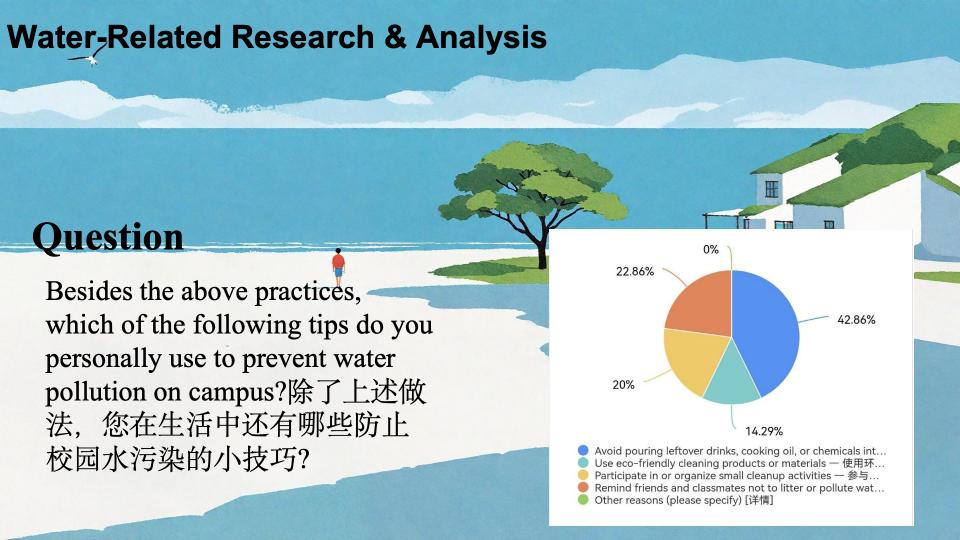
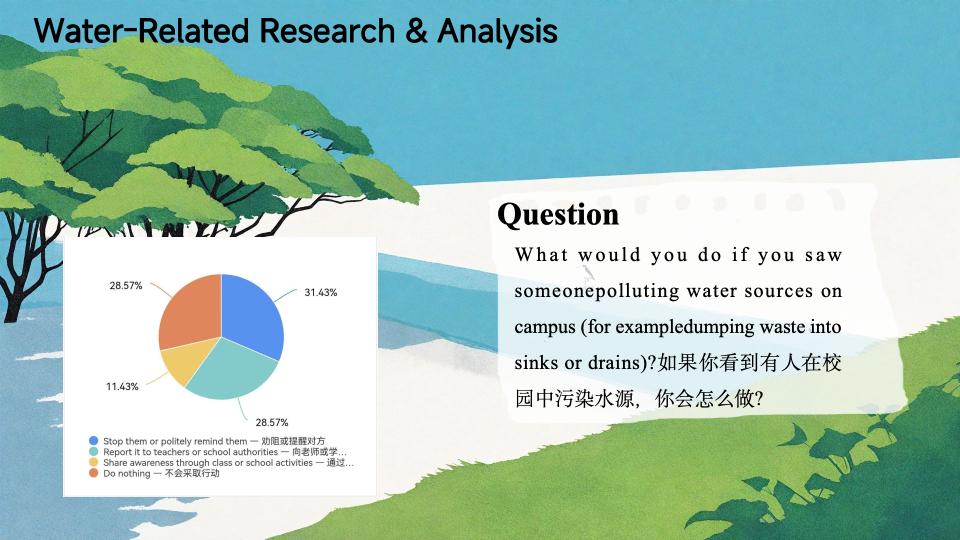
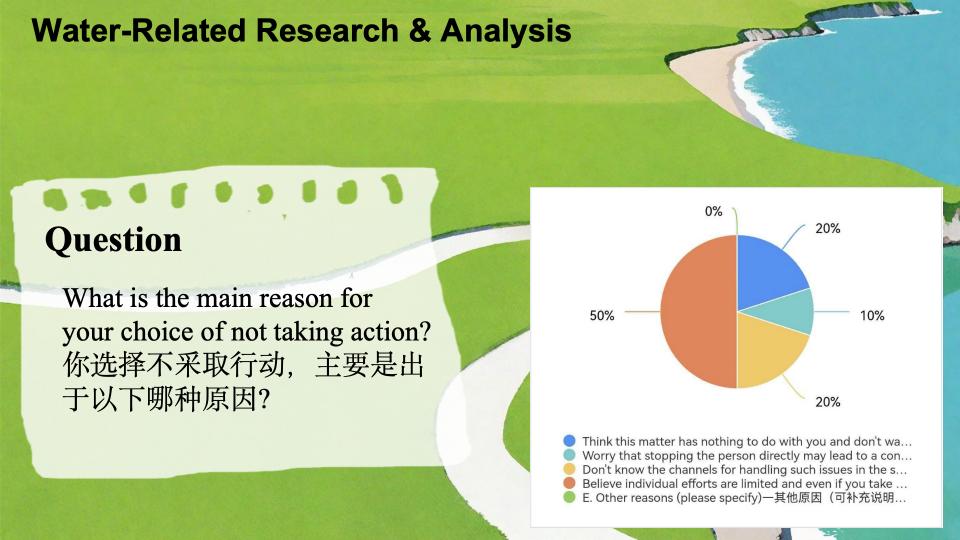
With this evidence in mind, we built our video around a clear line of thinking: present the problem, explain why it matters, and suggest practical solutions. In the video, we highlighted two major problems. The first was students' unconscious pollution, such as throwing small pieces of trash near the pond. The second was the limited self-purification ability of the pond water, especially when debris and decaying plants collect over time. We then proposed two solutions. First, the school could install a simple filtration and circulation device to improve pond water quality. Second, students could be reminded not to throw waste into water areas through posters, short announcements, or a water protection reminder campaign. In one interview scene, I asked what might happen if someone dropped a piece of tissue into the pond. This small question helped show that small behaviors can slowly create larger environmental problems.
Reflecting on this project helped me understand both water protection and the process of doing research. When I interviewed teachers and students, I learned that open-ended questions could lead to better answers than simple 'yes or no' questions. I also practiced adjusting my tone and body language during filming so that our message would sound clearer and more persuasive. At the same time, working with my group taught me how to divide tasks, communicate under a deadline, and connect different parts of the project into one final product. Most importantly, I realized that our campus is like a small model of a larger society. If students can notice pollution, collect evidence, and suggest solutions in school, they can also use the same thinking to solve bigger community problems in the future. For me, this project was not only a video task, but also an early experience in research, analysis, and problem-solving.
Grade:Y9
Class: Shor 517
Reporter: An (Cole) Xie
International Department, The Affiliated High School of SCNU